With the growing use of lithium-ion batteries in vehicles, the requirements for safety, traceability, and risk management in testing processes are also increasing. When testing energy storage systems, the focus is therefore on protecting people, equipment, and the environment.
Modern test chambers must not only simulate precise environmental conditions, but also be prepared for potential hazards such as gas leaks, fire, or explosions. The EUCAR Hazard Level provides a reliable classification of the potential hazard and serves as the basis for the safety-related design of our test chambers.
What does the EUCAR Hazard Level mean?
The EUCAR Hazard Level describes the hazard levels for battery testing – from “no effect” (Level 0) to “explosion” (Level 7). Depending on the hazard scenario, appropriate protective measures must be in place on the test chamber – from electric door locks and CO and H₂ detection to rupture discs, inerting systems, or a high-pressure water mist system (HPWMS).
Our test chambers can be adapted precisely to the required test requirements:
- Basic package (level 0–3*): Basic protection and temperature monitoring
- Package II (level 0–4*): Additional pressure relief and CO and H₂ monitoring
- Package III (Level 0–5): Fire detection, CO₂/N₂ inerting, and an HDWN
- Package IV (Level 0–6/7*): Rupture discs, permanent nitrogen inerting, O₂ measurement
This gives you a high level of safety for your battery tests – regardless of cell type, cell chemistry, or test environment.
What does EUCAR mean?
EUCAR stands for: European Council for Automotive R&D
The research organization of European automobile manufacturers was founded to promote joint research and development work in the European automotive industry and to harmonize safety, environmental, and technology standards.
When is a hazard level test chamber required?
A test chamber in accordance with EUCAR Hazard Level is required when working with active and charged energy storage systems in e-mobility or battery research – i.e., with lithium-ion cells, modules, or complete batteries that may degas or undergo a thermal reaction in the event of a fault.
This applies in particular to functional, endurance, and abuse tests where heat or gas generation, fire, or explosions cannot be ruled out. In such cases, the risk must be limited – by using a test chamber that is designed in accordance with the assigned hazard level.
An EUCAR-compliant test chamber gives you the assurance that the test object is being tested safely and that employees, the environment, and the facility are reliably protected.
Who determines the required hazard level?
The classification of the test, taking into account the hazard level, must be determined by the equipment operator. For this purpose, a risk assessment must be carried out in accordance with § 3 of the German Industrial Safety Regulation (BetrSichV).
Not only must the hazards posed by the work equipment itself (e.g., risk of crushing when closing the equipment door) be taken into account, but also interactions with the working materials used (e.g., the test material battery cells) and the working environment. For this reason, in many cases, the Hazardous Substances Ordinance must also be observed.
In this assessment, you as the equipment operator evaluate, among other things:
- the cell type and chemical composition,
- the test conditions and energy contents,
- as well as the possible reaction and error scenarios (e.g., gas leakage, fire, explosion).
The result of this assessment is the classification into a specific EUCAR hazard level (0–7).
Depending on the level specified, different safety equipment options are available for the test chamber.
This ensures that the test chamber is precisely tailored to the hazard potential of the test material – and that operation can be carried out safely, in compliance with regulations, and efficiently.

* The occurrence of a flame or fire requires the presence of an ignition source, a combustible substance, and oxygen in a combustible/ignitable mixture. As soon as an ignition source is present and the escaping liquid (electrolyte) or gases are combustible, Hazard Level 3 or 4 inevitably becomes Hazard Level 5.
Who builds the test chamber according to the hazard level?
Once the operator has defined the hazard level as part of their risk assessment, WKM takes care of the technical implementation.
Our test chambers are designed and equipped precisely according to the required hazard level – with safety-relevant components such as:
- Electric door locking,
- CO, O₂, and H₂ sensors,
- Pressure relief valves,
- Inerting systems with CO₂, N₂, LN₂, or HDWN
- as well as rupture discs for controlled pressure relief.
This means that our systems comply with the current EUCAR and BetrSichV requirements and guarantee maximum safety for battery and e-mobility tests.
Special note on hazard levels 3 and 4
The occurrence of a flame or fire requires the presence of an ignition source, a combustible substance, and oxygen in a combustible/ignitable mixture. As soon as an ignition source is present and the escaping liquid (electrolyte) or gases are combustible, Hazard Level 3 or 4 inevitably becomes Hazard Level 5.
The operator must check whether the materials used in the lithium-ion cells are combustible, can form explosive gases, and whether O₂ is produced during outgassing. The relevant data for flammable substances are the flash point and ignition temperature. The test must also take into account possible chemical reaction results such as sudden increases in the volume of the reaction partners.
A common component of the electrolyte is, for example, highly volatile dimethyl carbonate (DMC) with a flash point of +16 °C. This means that in the event of an electrolyte leak (definition: hazard level 3) and a test room temperature ≥ +16 °C, the vapors produced can be ignited by an open flame, a correspondingly hot surface (e.g., electric heating elements in the test chambers), or an ignition spark.
Without additional safety measures, a maximum of 50% LEL may therefore be reached in the event of a leak of flammable media. If this limit is exceeded by the possible amount of flammable media leaking, additional safety equipment is mandatory even at hazard levels 3 and 4.

* Prerequisite: gas or liquid (electrolyte) escaping from the cell is non-flammable. Please note the information on hazard levels 3 and 4.
** Note: Level 7 may only be present with a very small risk as a tolerable residual risk.
*** Flushing device with on-site supply of CO₂, N₂, or LN₂.
Alternatives:
- CO₂ flushing device with its own compressed gas cylinder
- High-pressure fog extinguishing system
Safety equipment for battery test chambers
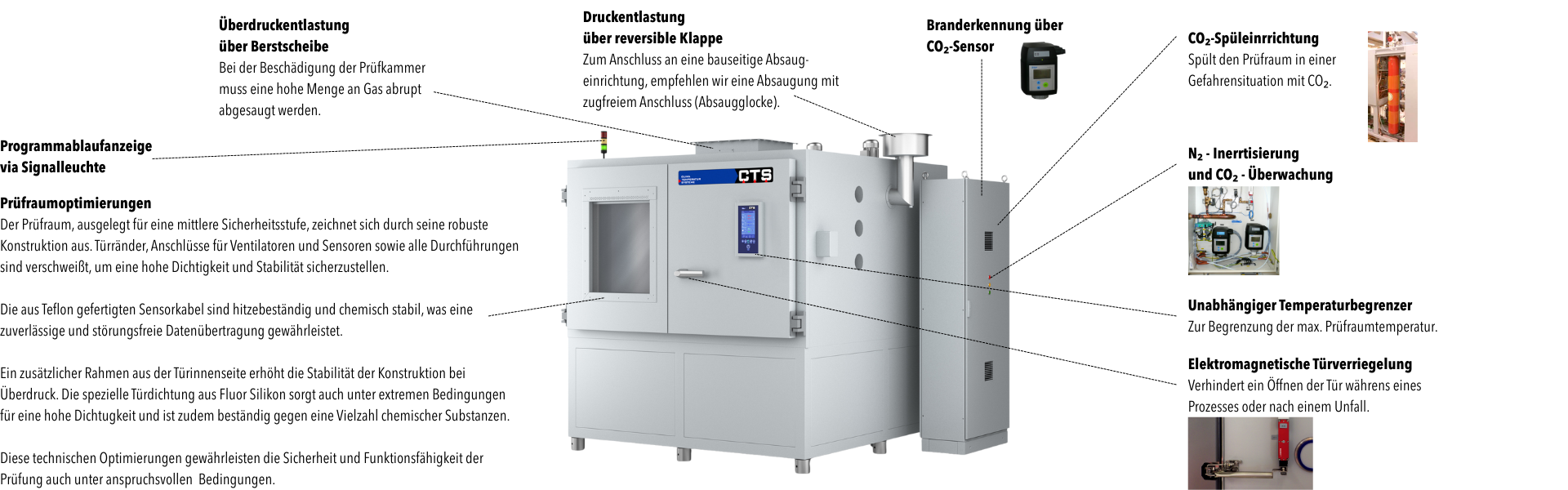
Optional safety and equipment features
Additional equipment options are available to increase safety, testing capabilities, and compliance with standards:
- Rupture diaphragm with increased pressure resistance of the test chamber
- Compressed air dryer for moisture reduction
- Safety temperature limiter and release contact for test material control
- HDWN high-pressure water mist extinguishing systems
- Combination with water-glycol temperature control
- Media-resistant device design
- Storz coupling for extinguishing water feed
- Temperature measurement directly on the test material
- Air- or water-cooled condensers
These options enable comprehensive work – tailored to the respective test processes, media, and safety requirements.
Note on personal protection and residual risk
All safety and additional equipment on test chambers primarily serve to protect people in the event of an accident.
However, despite all safety and additional equipment, a residual risk must be expected. In the event of a fault, damage to the test chambers and/or equipment cannot therefore be completely ruled out.
In the event of a potential hazard level 7, it is recommended that the test chamber be installed in a secure area – e.g., in a separate, locked installation room with no access for personnel during the test. In addition, a separate exhaust air system should be provided to safely remove gases, smoke, or dust from the test area.

![[Translate to Englisch:]](/fileadmin/_processed_/c/d/csm_Temperaturpruefschraenke_KLimapruefschraenke_Binder_CTS_ddb5618ab2.webp "[Translate to Englisch:]")
![[Translate to Englisch:]](/fileadmin/_processed_/c/d/csm_Temperaturpruefschraenke_KLimapruefschraenke_Binder_CTS_755ebbfb53.webp "[Translate to Englisch:]")
