Chamber dryer according to DIN EN 1539
Drying cabinet
Solvent-based substances
Flammable substances
Safety in heat treatment –
furnace systems in accordance with DIN EN 1539
Heat treatment – such as paint drying, impregnated resin processing, or surface coating – often produces combustible vapors and solvent-containing atmospheres. These can quickly become hazardous if the equipment is not operated properly.
If the amount of solvent introduced per batch can be limited and is known, then no ATEX furnace is required. In this case, an furnace in accordance with DIN EN 1539 can be used. This standard specifies the safety requirements for dryers and industrial furnace in which combustible substances are released. This ensures safe and standard-compliant operation – from the painting process to resin drying.
The advantages of furnace in accordance with DIN EN 1539:
The structural and spatial requirements for the installation site are easier to implement. The systems can be installed in neutral or even fire-hazardous areas. You have more planning freedom. This reduces your investment and operating costs while meeting the highest safety standards.
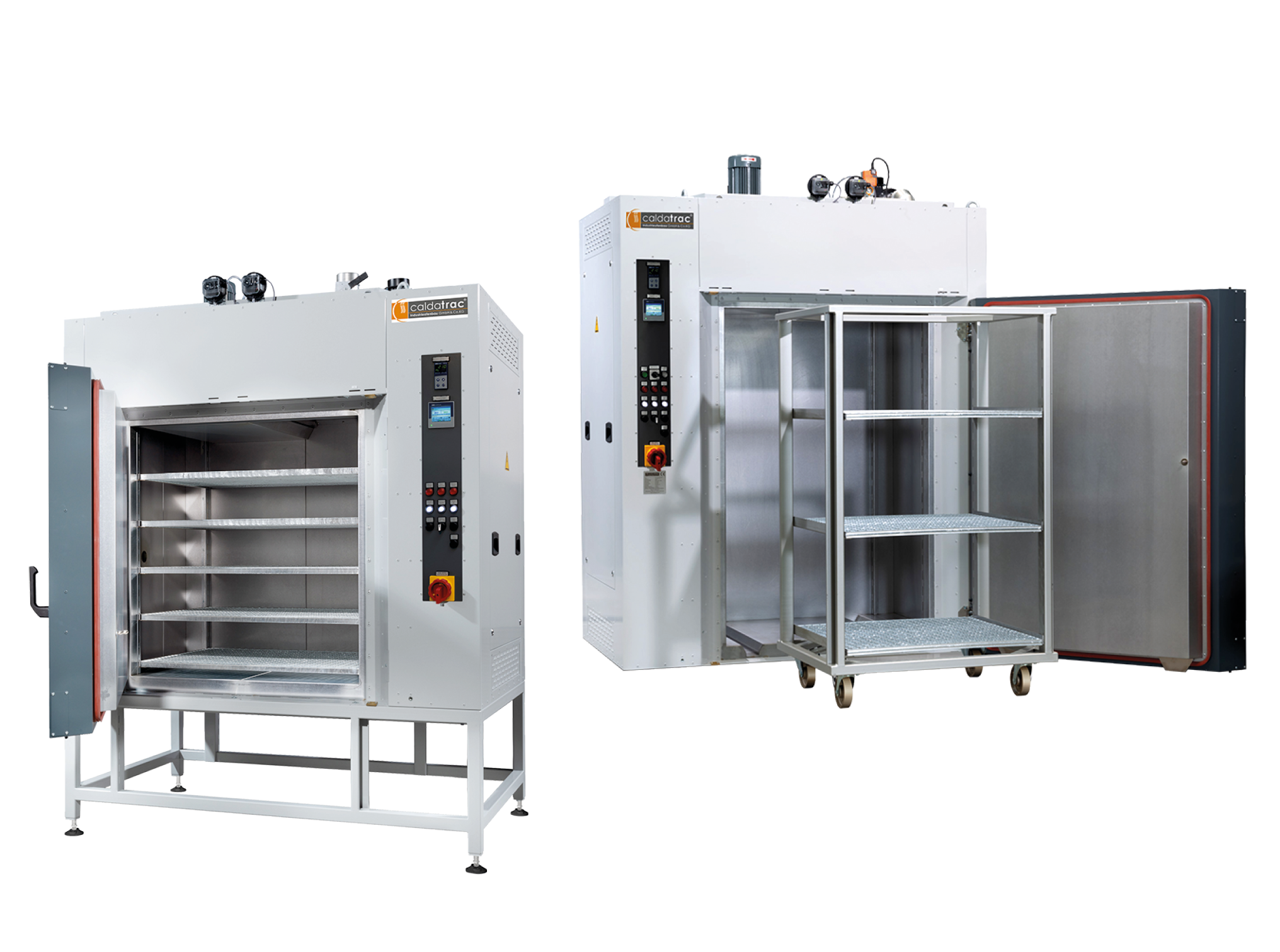
Drying – what exactly does that mean?
Drying refers to the removal of liquids from a material or component through evaporation. If not only water but also solvents or other combustible substances evaporate in the process, the furnace must be designed in accordance with safety-related framework data.
This applies to all drying processes that produce VOC-containing vapors, regardless of whether a product is officially advertised as “solvent-free.”
A review of the safety data sheet for the material used will show whether it contains combustible components.
What does DIN EN 1539 say?
DIN EN 1539 is a European safety standard for dryers and furnaces in which combustible substances or solvents are released. It defines the technical requirements for preventing an explosive atmosphere and ensuring safe and reliable operation.
Typical applications include the drying of:
- Surface coatings
- Mold coatings
- Adhesives
- Impregnating resins
- and other materials containing volatile organic compounds (VOC)
The 3% rule – the decisive limit value
If the concentration of combustible solvent vapors released during the drying process is below 3% of the LEL, there is no explosion hazard as defined by DIN EN 1539 – the dryer does not have to be designed in accordance with DIN EN 1539 or ATEX.
If the limit value is exceeded, the complete safety requirements of DIN EN 1539 apply, including monitoring of the solvent concentration, temperature control, and design of the exhaust air system.
If the amount of solvent released is unknown, it can be determined, for example, by measuring the loss on drying (weighing before and after). Depending on the batch size and the type/quantity of substances released, the furnace can be designed for the specific application.
How to check the 3% rule:
Step 1 – Weigh the batch before drying (total mass before the start of the process - Mbefore)
Step 2 – Weigh the batch after drying (total mass after the end of the process – Mafter)
Step 3 – Calculate the amount of solvent evaporated → Msolvent = Mbefore - Mafter
Step 4 – Calculate the amount of solvent at 100% LEL in the furnace chamber:
M₍LEL₎=(LEL × V × ρ × M)(100 x R x T) (Simplified representation)
Step 5 – 3% limit for solvent vapors → M3%LEL= 0.03 x MLEL
Evaluation:
→ If Msolvent < M3%LEL → below 3% → DIN EN 1539 generally not required.
→ If Msolvent > M3%LEL → above 3% → Design according to DIN EN 1539 required.
Note: This calculation is intended as a simplified estimate.
The 3% rule of DIN EN 1539 refers to the concentration of combustible vapors in the furnace atmosphere, measured as a volume percentage (%) of the LEL. The mass balance is a practical approximation, but does not replace an accurate concentration calculation.
Under no circumstances may the concentration exceed 3% of the LEL, even for a short period of time.
Example - Solvent curve of a furnace system according to DIN EN 1539
The maximum permissible mass of combustible substances is specified for each system and clearly communicated to the operator via the type plate and operating instructions. Appropriate work instructions ensure safe operation, even in processes involving released solvents.
The solvent curve shows the maximum permissible solvent quantity for an industrial dryer type CDF 100/100/150-20, designed in accordance with DIN EN 1539 – Dryer type A – Range 1. At a process temperature of 200 °C, the maximum mass of combustible substances per batch must not exceed 34.9 g.
The diagram shows:
As the temperature rises, the permissible amount of solvent decreases in order to prevent the formation of an explosive atmosphere.
![[Translate to Englisch:] Lösemittelkurve - Industrieofen](/fileadmin/user_upload/Wer_erklaert_einfach/DIN_EN_1539/Diagramm_Ofenanlage_CDF_100-100-150-25__OC_18824_.png)
What if ...?
...the amount of solvents released cannot be clearly determined?
Then a system in accordance with ATEX is required. In this case, it must be assumed that explosive atmospheres can occur.
The information in the safety data sheets is crucial for preparing a risk assessment. They help to assess whether the product used can create a combustible or explosive atmosphere. If the safety data sheet is missing, the necessary information on the substance name, ZVG or CAS number can be found in the GESTIS substance database: https://gestis.dguv.de/search
Furnaces and dryer chambers types according to DIN EN 1539
DIN EN 1539 distinguishes between two types of dryers: Type A and Type B.
The classification is based on the amount of combustible solvent vapors released and the necessary safety measures.
Dryers Type A dryers operate in an air atmosphere and are designed for processes in which only limited amounts of combustible substances are released. The vapor concentration remains safely below the explosion limit thanks to controlled exhaust air flow and monitoring.
In practice, a distinction is made between two designs:
- Area 1 - Designed so that the concentration of solvent vapors in the entire vapor space is significantly below the LEL - up to approx. 40% LEL.
- Area 2 - The concentration may rise to approx. 60% LEL and is additionally controlled by continuous solvent monitoring. This ensures that the atmosphere in the dryer remains below the explosion limit at all times.
Dryers type B are used when larger quantities of solvents are present or when the formation of explosive mixtures can only be prevented by inerting. They operate in a protective gas atmosphere (e.g., nitrogen) with reduced oxygen content to reliably prevent ignition. These dryers are subject to increased requirements for monitoring, temperature control, and explosion protection.
![[Translate to Englisch:] Trocknertypen nach DIN EN 1539](/fileadmin/_processed_/2/8/csm_Trocknertypen_nach_DIN_EN_1539_cb7ff4e436.png)
Note: The graphic shows the ranges for furnacesaccording to DIN EN 1539 and is for guidance only. With the dryer types shown, we are operating below the LEL.
The 3% line marks the limit below which no design according to DIN EN 1539 is required. From 65% LEL, inerting, i.e., displacing the oxygen in the air with inert gas, prevents the formation of an explosive atmosphere. In this range, inerting and the use of a type B dryer are necessary.
LEL = Lower Explosive Limit (UEG = Untere Explosionsgrenze)
UEL = Upper Explosive Limit (OEG = Obere Explosionsgrenze)
(end of the explosive range)
How the safe drying process works
During drying, the evaporated liquid is removed via an exhaust fan. This creates a continuous exchange of air, which prevents the formation of explosive vapor-air mixtures in the steam chamber/usable space.
Central safety measures according to DIN EN 1539 – Type A dryer, Zone 1, are:
- Electrically monitored fresh air supply (fail-safe principle)
- Monitoring of the minimum exhaust air volume flow
- Automatic shutdown of the heating in the event of a fault
- Purging processes before heating to remove any solvent pockets
- Mechanically safe design to prevent solvent accumulation
These measures are implemented and documented via safety controls with performance level monitoring. In area 2, the safety measures for dryer type A (area 1) are usually supplemented by concentration monitoring.
It must be ensured on site that the exhaust air is safely discharged in order to protect the workplace and the environment. Please feel free to contact us for more information.
High energy consumption? Not with our furnaces.
Due to the constant exchange of fresh air in the furnace, the cooler supply air drawn in from the installation site must be repeatedly heated to process temperature. This requires a lot of heating power.
This is understandable during the heating phase – but during the holding phase, which often lasts several hours, it is not optimal from an ecological and economic point of view. Drying systems in accordance with DIN EN 1539 are therefore among the most energy-intensive systems in production. With precise process monitoring and intelligent control, significant savings potential can be realized here.
Supplemented by a heat recovery system, such as a cross-flow heat exchanger, the heat from the exhaust air is used to preheat the fresh air. Alternatively or in addition, concentration monitoring can also be used to regulate the required exhaust air volume flow.
This lowers energy consumption, reduces CO₂ emissions, and increases efficiency—without compromising safety.
![[Translate to Englisch:] Energierückgewinnung_Kreuzstromwärmetauscher](/fileadmin/user_upload/Wer_erklaert_einfach/DIN_EN_1539/Industrieofen_mit_Kreuzstromwaermetauscher___Energierueckgewinnung.png)
Your partner for custom-made industrial furnaces
From the initial consultation to design and commissioning, we are your reliable partner every step of the way.
Together, we develop the furnace that perfectly suits your processes —
for precise, economical, and future-proof heat treatment in industry.
Send inquiry >


